
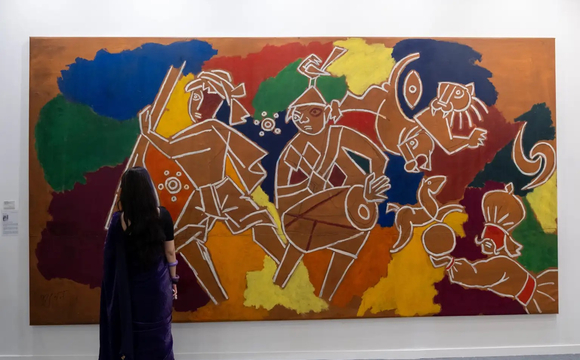
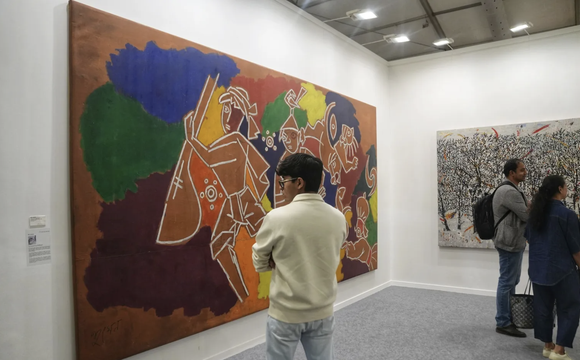
Doubling down, Aicon Contemporary—the gallery’s newer branch dedicated to contemporary artists—featured what was likely the most expensive work at the fair: a monumental and historically significant painting by M.F. Husain, Goopy Gyne Bagha Byne (Homage to Satyajit Ray), 1990, priced at $5 million. The presentation followed Husain’s $13.75 million record at Christie’s South Asian Modern and Contemporary Art auction in New York in March 2025. Widely regarded as India’s pre-eminent post-independence painter, Husain dedicated the work to Satyajit Ray, the most critically acclaimed Indian filmmaker of the same period, on the occasion of Ray’s Oscar recognition. The extended canvas format evokes a cinematic screen, creating a life-size encounter with its playful figures. Husain frequently drew inspiration from Ray’s films; in this case, the reference is to Goopy Gyne Bagha Byne, the first film in Ray’s iconic Goopy-Bagha trilogy, sharing the same sense of playfulness and vibrant palette.
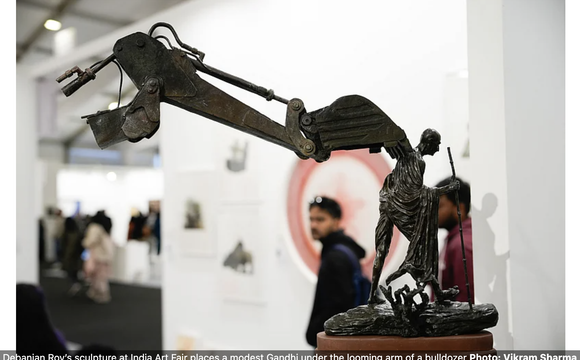
At the India Art Fair this year, amid a wide range of artistic practices on display, Debanjan Roy’s sculpture offers a distinct visual and political proposition. Installed at Aicon Contemporary’s booth, the bronze figure of Mahatma Gandhi is instantly recognisable, but without grandeur. Behind Gandhi looms the arm of a bulldozer, a demolition hammer frozen mid-gesture. The juxtaposition is jarring, deliberate, and deeply unsettling.
The sculpture draws from the visual grammar of the Gyarah Murti, the iconic marching Gandhi monument in Delhi. But Roy fractures that image by introducing an industrial weapon , a machine arm associated today not with development, but with punishment. Asked about the bulldozer, Roy does not hedge. “It represents power,” he said simply.
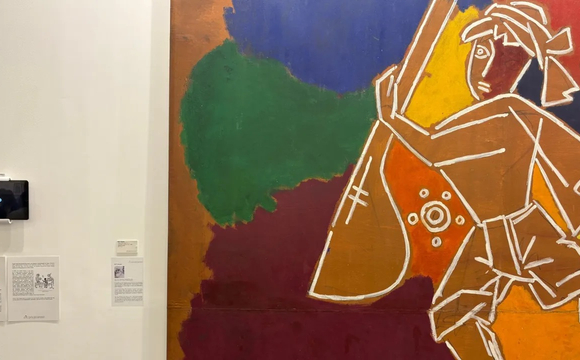
Indian legends are not far behind. At DAG's Booth, stone artefacts and art history, anchor a booth that also features Satish Gujral and M.V. Dhurandhar. The Kiran Nadar Museum of Art's Tyeb Mehta IAF parallel retrospective looms large in parallel programming, as 100 years of Satish Gujral claims space at the National Gallery of Modern Art, whilst Aicon Contemporary draws collectors with M.F. Husain's Goopy Gyne Bagha Byne, a tribute to Satyajit Ray commanding both reverence and serious rupees. Somnath Hore has a whole gallery dedicated to her legacy at Crayon Art Gallery.
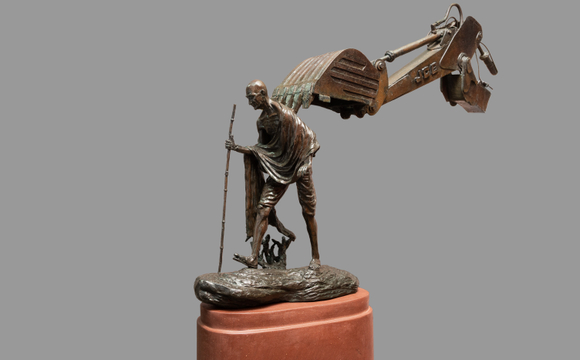
At the 17th edition of India Art Fair, opening to the public on Friday, a bronze sculpture by Debanjan Roy — inspired by Gyarah Murti — commands instant attention at the entryway of Aicon Contemporary, a New York-based gallery and long-time participant. Roy, a Kolkata-based artist, distils the historic procession into a solitary, walking figure of Gandhi and radically alters its context. Suspended behind him is a demolition hammer, its heavy industrial form attached to the figure of Gandhi to the figure's forward movement. Associated with construction sites and, more recently, highly publicised state demolitions, the machine introduces a stark counterpoint to the ethical force of the original marchers.
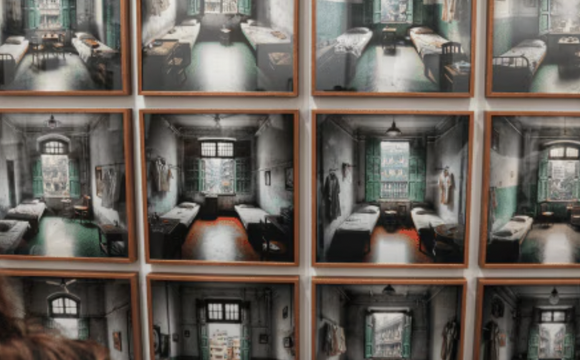
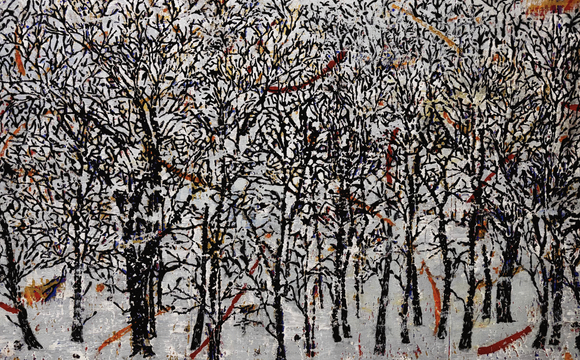
Emerging Voices and Galleries: In addition to established artists, the fair includes innovative programmes from galleries like Aicon Contemporary and Iram Art, spotlighting emerging talent and diasporic perspectives — for example, works exploring rural narratives and cultural memory.
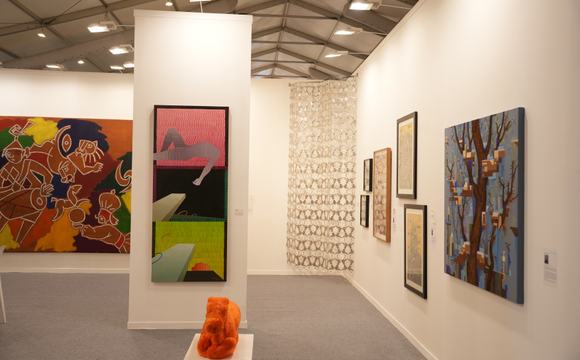
The four days of the fair feature some of India’s most important contemporary galleries, including Archer Art Gallery, Art Exposure, Chawla Art Gallery, DAG, Kumar Gallery, Akara, Chemould Prescott Road, Vadehra Art Gallery, Chatterjee & Lal and Gallery Espace among others. International galleries such as David Zwirner, neugerriemschneider, Galleria Continua and Aicon Contemporary are showcasing works by renowned South Asian and diaspora artists, including Huma Bhabha, Shilpa Gupta, Anish Kapoor and Adeela Suleman respectively.
Inside the tents at the fair, some works drew more attention than others. Projjal Dutta, partner at New York-based Aicon Contemporary, who has participated in the fair for 16 consecutive editions, said, “One big change over time is that initially art would go from here to the United States and we would only send funds back to India, but now India has also emerged as a big market.” At his booth, apart from works by contemporary artists such as GR Iranna, Arunkumar HG, and Jagannath Panda, there is also MF Husain’s painting Goopy Gyne Bagha Byne — a tribute to filmmaker Satyajit Ray — displayed.
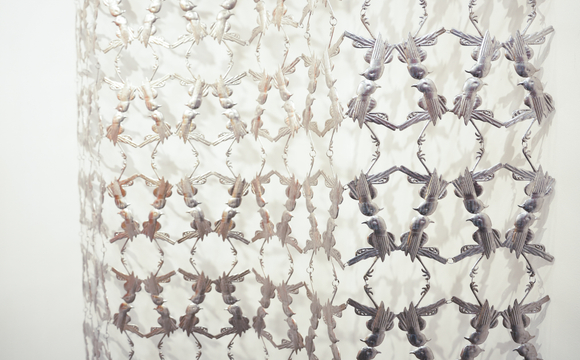
In what is being touted as one of its most ambitious programmes, in its 17th edition IAF will see a record 133 exhibitors — including 94 galleries, regional and international art institutions — 26 of which will make their debut. While modernists such as MF Husain, SH Raza, B Prabha, Meera Mukherjee, P Perumal and TRP Mookiah will share space with contemporaries such as LN Tallur, Prabhakar Pachpute, Sohrab Hura, Lubna Chowdhary, Ravi Agarwal and T Venkanna, the fair will also see South Asian and diaspora artists such as Huma Bhabha (David Zwirner), Anish Kapoor (Galleria Continua), Adeela Suleman (Aicon Contemporary) and Jagath Ravindra (Saskia Fernando Gallery).
Taking place at NSIC Okhla Ground till February 8, with 135 exhibitors, the works at the India Art Fair range from modern masters to emerging talent, participatory installations, photography and experimental material practices to folk narratives. Here is a section-wise guide to some of the key works and artists across the fair.